The floral bath (mandi bunga) ritual

The Russian musician Igor Stravinsky might have composed Le Sacre du Printemps (The Rites of Spring) as an exploration of nature and the rituals of renewal and sacrifice, but one could safely conjecture that the ritual and ceremony of the Malaysian floral bath was created for more personal (and less lofty) reasons. The two may be worlds apart, but both Stravinsky and the local bomoh share one thing – invoking the power and the mystery of nature and the elements in their work.
Continue Reading
Sanctum sanctorums of the Thai and Burmese communities

In 1845, a large endowment of land in the Pulau Tikus area was made to the Theravada Buddhists, principally Thai and Burmese, whose importance is recorded in local street names to this day. Today, the extensive lands surrounding the Thai Wat Chaiyamangalaram are home to a small and thriving kampong of about thirty families (approximately 120 persons) of Thai Chinese and Hindu Indians. (The Changing Perceptions of Waqf, as Social, Cultural and Symbolic Capital in Penang, Judith Nagata)
Continue Reading
Traditional Malay cooking at Lagenda Café in the heart of George Town

The key signature in traditional Malay cuisine is definitely the generous use of local herbs, spices and belacan (shrimp paste). Santan (coconut milk) is a common addition to impart a creamy texture to Malay dishes. In Penang and the northern states of Malaysia, Malay cooking has further integrated Thai flavours. Meats and seafood are usually marinated with a special blend of herbs and spices before being cooked. Vegetables are often stir-fried and some eaten raw, always with sambal belacan. I love Malay dishes because of their strong, spicy and aromatic oomph. For an authentic Malay feast, visit Lagenda Café.
Continue Reading
"Roti! Roti!", the lure of the bread man

The 'roti man' or bread vendor is quite a common sight in Penang. They are usually on their rounds in the mornings and from tea time, plying their stock-in-trade in a road contraption that resembles a hybrid between a motorcycle and a 'meat safe'.
Continue Reading
Savoury Or Kuih (steamed yam cake) recipe from Lily Wong
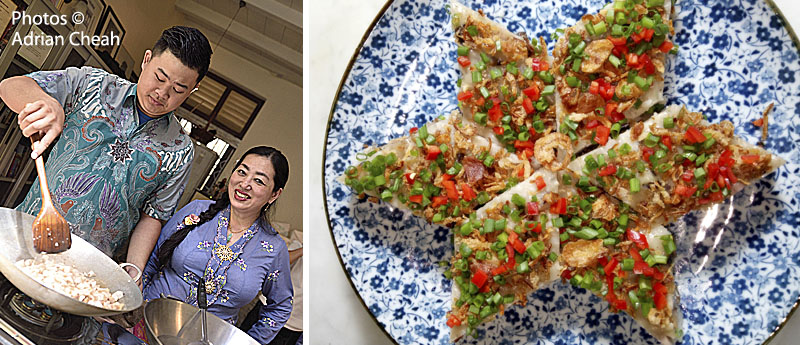
"Yam", as it is often known in Penang, actually refers to taro. While "yam" encompasses various plant species in the Dioscorea genus with edible tubers, Or Kuih specifically uses taro. For local authenticity, I'll stick with "yam". Or Kuih, a steamed yam cake, is a lovely local delicacy topped with aromatic shallot oil, fried dried shrimps, crispy shallots, spring onions and diced chillies. Traditionally served with chilli sauce or "tnee cniau" (sweet sauce) on the side, this dish embodies comfort food. A perfect slice of yam cake should be aromatic and tender, with yam chunks that melt in the mouth.
Continue Reading
PARKROYAL Penang Resort – a tropical paradise to luxuriate in
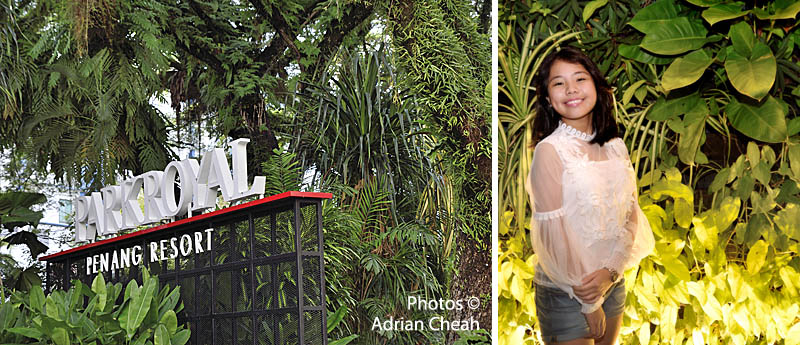
For two consecutive years, my daughter has requested the same birthday gift – a weekend at PARKROYAL Penang Resort. The Resort has been one of her favourite places to kick back and lose herself in a tropical paradise.
Living in Penang, we are indeed fortunate that we can just take a 35-minute drive from home to Batu Ferringhi sans the arduous plane and taxi rides (e.g., my cousin from Toronto took some whooping 23 hours to reach Penang).
Continue Reading