The Sari: Queen of garments

The amazingly versatile sari (or saree) transcends mere fabric – it embodies the rich heritage of traditional South Asia women (and a few men) in countries such as India, Pakistan, Bangladesh, Sri Lanka and Nepal. It is also a garment that covers all, yet is revealing, enchanting yet unassuming, serene yet sensuous. The sari, with its six yards or more of artistry, is a masterpiece of contradictions, seamlessly transitioning from workwear to leisure attire to a symbol of opulence, all within its elegant drapes.
Continue Reading
My understanding of All Saints' Day

Images of St. Joseph from the Roman Catholic Penang Diocesan Museum, Farquhar Street, Penang.
Can you name five saints, even if you are not Catholic? Perhaps the first name that comes to mind is St. Anne, honoured in Christian tradition as the mother of Mary and grandmother of Jesus. Her legacy endures in the Minor Basilica of St. Anne in Bukit Mertajam. Beside her stands her daughter Mary, the mother of Jesus, two figures whose stories continue to inspire and move people across generations.
Continue Reading
Tow Boo Kong Temple—an epic edifice where gods descend on Earth

At the northern end of Jalan Raja Uda, where the ordinary rhythms of Butterworth give way to the extraordinary, Tow Boo Kong Temple rises in a blaze of colour, craftsmanship and celestial ambition. One of the most celebrated places of worship in Seberang Perai, this magnificent Taoist sanctuary is dedicated to the Nine Emperor Gods, whose annual festival draws devotees and curious onlookers into its orbit. Its grandeur belies humble beginnings. In the early 1970s, the temple was little more than a modest shrine beneath an attap roof. By 2000, it had been transformed into the monumental complex seen today, its splendour crowned by an imposing entrance archway completed in 2009.
Continue Reading
La Vie en Mei Gui Café—Between Buckingham and Penang
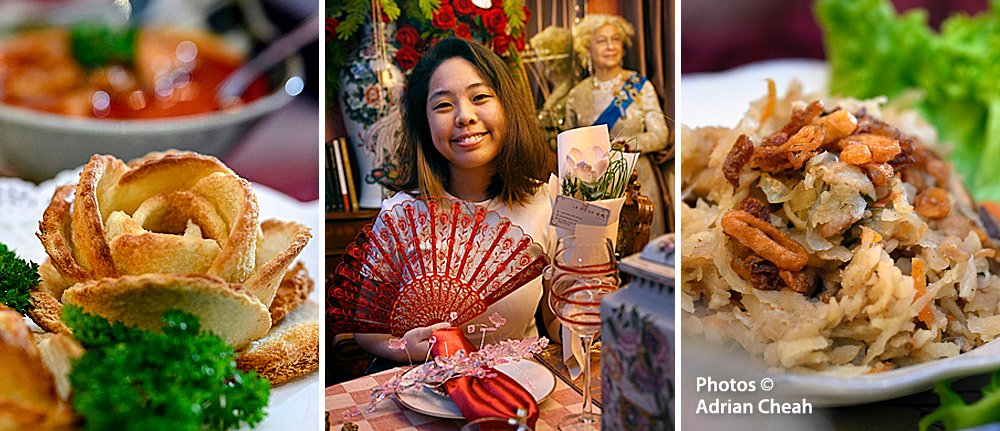
Walking into La Vie en Mei Gui Café with my daughter for lunch brought back a rather unexpected memory. At the entrance, you are greeted by Prince William and Kate Middleton, while upstairs at the landing, Queen Elizabeth II stands in regal splendour. Chandeliers hang above, grand floral arrangements fill the rooms, and gilded details sit against lush crimson. British memorabilia completes the setting, with every corner arranged almost like a picture postcard. John H'ng has certainly embraced the theme wholeheartedly.
Continue Reading
Kek Lok Si Temple, the monastery on Crane Hill

In Chinese iconography, the Crane holds special significance. It is an auspicious symbol denoting longevity, and wisdom that comes with age. The Crane is said to manifest a peculiar interest in human affairs and is also often associated with good luck, high-mindedness, purity and freedom.
Continue Reading
Stitching Through Hardship: A Nyonya's War-Time Chronicle

At the Church of the Assumption, nestled amidst the bustling streets of George Town, the hearts of Louis Michael Martin and Emily Elizabeth Surin became forever entwined. Their love story found its new beginning on 7 August 1926, when Rev. Fr. P. Lerond officiated their marriage. The church would have looked somewhat different then from the one we see today, as it underwent a major renovation in 1928, when two wings were added.
Continue Reading