Nasi lemak – a parcel of Malaysian goodness

A favourite breakfast dish for most Malaysians is Nasi Lemak – something which transcends the often-tenuous ethnic boundaries in this multi-racial country, as Malays, Indians and Chinese, all love it!

Coconut milk, chillies and belacan (shrimp paste) are among the main ingredients in Malay cooking. Rice and curry feature consistently while a must-have side accompaniment with every meal is the spicy sambal belacan, a potent concoction of chillies, shrimp paste and lime juice. Other finger-licking variations of the sambal dip are sambal belimbing which is made with baby star fruit (belimbing), chillies and grated coconut, and ‘sambal kicap’ which consists of cut chillies in sweet soy sauce, tomatoes, shallots and lime juice.
Malay food stalls are a permanent feature in Malaysian streets, whether urban or rural, offering a varied menu of the savoury, spicy and sweet. The stalls are literally a one-stop, drive-in eatery for the busy office crowd in search of a complete meal. After a spicy meal, a refreshing drink to cool the mouth and throat is ais manis or rose syrup served with shaved ice, with or without milk.
Nasi lemak

The favourite breakfast dish for all Malaysians. Nasi lemak is rice cooked with coconut milk and served with spicy ikan bilis (anchovies), peanuts, sambal (spicy gravy), sambal prawn or fish, eggs, long beans and cucumbers. Nasi lemak is available either pre-packed in newspaper and banana leaf or 'buffet' style. The latter allows the customer to choose the lauk (dishes) like sambal squid, fried/hard-boiled egg, fried fish, vegetables, curry chicken or beef to go with the nasi lemak.
Purists say that nasi lemak ought to be eaten in an authentic setting, nasi lemak should be eaten at a mamak teh tarik stall (wooden pushcart with wooden bench and tables arranged by the roadside, normally under a shady tree) and wash it down with a cup of teh tarik (literally translated to mean “Pull Tea” – or tea that is poured in mid-air from one container to another).
Satay

Some say that this dish has Turkish roots. Be that as it may, satay has been available in Malaysia for many years already and is synonymous with Malay cuisine. In the olden days, satay sellers would carry their wares balanced on a long pole and propped on the shoulder, going from house to house in a village, calling out "satay! satay!" Whenever there was an order, the seller would there and then set up the stove, light the fire, roast the satay, and layout the food on a small makeshift table for eating!
Satay consists of beef, goat or chicken bite-size pieces marinated in spices, skewered onto thin sticks and grilled over a charcoal stove. The chef ensures thorough cooking of the meat by fanning the fire and turning the sticks of satay over at the right time. Satay is best eaten with its own spicy peanut sauce, ketupat (rice cakes) cucumber and raw onions.
Nasi Tomato
Tomato flavoured rice with servings of your choice: chicken kurma is recommended, although beef, mutton, seafood, egg and vegetables are also available. This rich meal will keep you sated for a long time. The cost depends on the dishes selected. Nasi tomato is also commonly served at Malay weddings.
Nasi Minyak
Note that the translation of this dish is not, as expected, oily rice but scented rice. Nasi minyak is rice cooked with butter, ginger, coconut milk, spices, raisins and almonds. Very popular at weddings and official functions. When an elder Malay asks a young person when she or he is going to serve nasi minyak, he really means to ask when they are getting married!
Popular Malay lauk (dishes to go with rice)


Appetisers, snacks and kuih

For some good Malay-style cooking, try these places.

---------------------------------------------------------
Written and photographed by Adrian Cheah © All rights reserved
Updated: 5 April 2019
A favourite breakfast dish for most Malaysians is Nasi Lemak – something which transcends the often-tenuous ethnic boundaries in this multi-racial country, as Malays, Indians and Chinese, all love it!
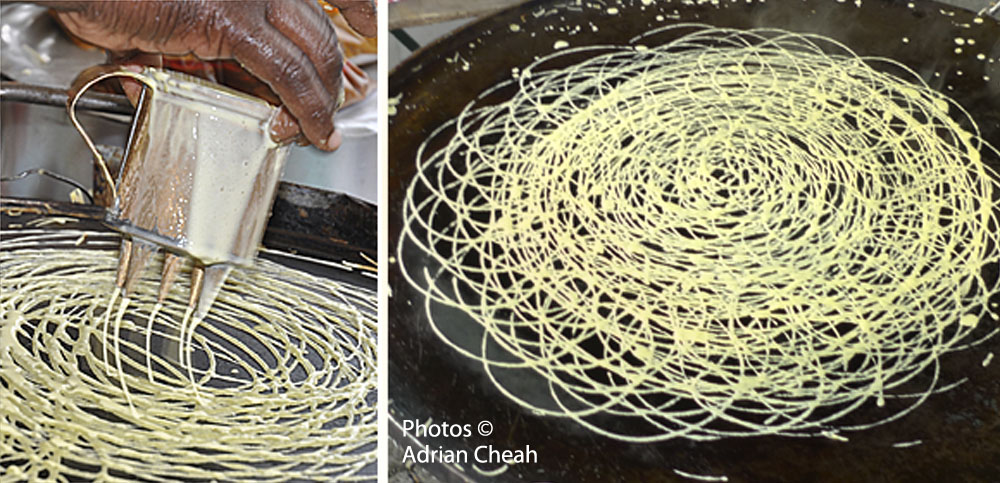
If you are a tourist in Penang during Ramadhan, you have to add the Ramadhan bazaar to your list of must-see places. The month-long Ramadhan bazaar (opens from 3:30 – 7:30 pm) offers a wide variety of Malay specialities and it is a wonderful market to scout for delicious treats. Roti Jala is something I will usually buy among many others.

Satay is an example of how Penang cuisine was greatly influenced by the Arabs who came here to trade from the Middle East. Some say that this dish has Turkish roots. Be that as it may, satay has been available in Malaysia for many years already and is synonymous with Malay cuisine.

Kuih Bahulu (also known as Kuih Baulu or Kuih Bolu) is a perennial favourite among Malaysians of all ages. In Hokkien, it is called Kay Nui Koh. It is a mini light and fluffy sponge cake made from eggs, flour and sugar. It has a slightly crusty outer layer with a soft and fluffy inside, quite similar in taste and texture to a French Madeleine. However, when compared to many western cakes, Kuih Bahulu is much lighter in texture and has a subtle sweetness.
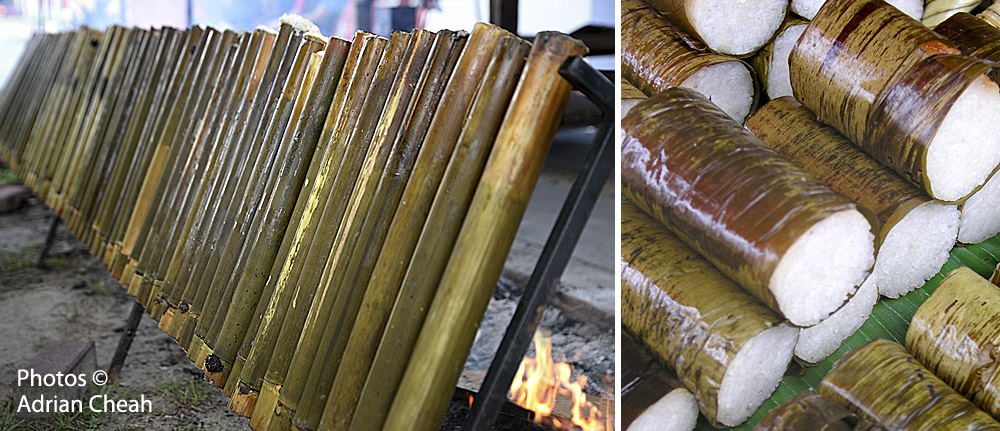
Lemang is available throughout the year in Penang and across Malaysia, yet it holds a special place during Hari Raya Aidilfitri (Eid al-Fitr) and Hari Raya Aidiladha (Eid al-Adha). Although the ingredients are simple, cooking lemang is labour-intensive and requires an open fire and a well-ventilated space. For this reason, many people prefer to buy it rather than cook it themselves.
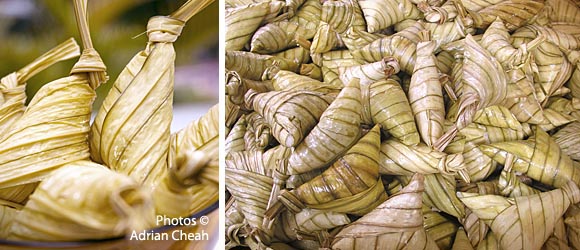
The most popular types of ketupat found in Malaysia are ketupat nasi (made with plain rice) and ketupat daun palas (made with glutinous rice). While both varieties are wrapped in palm leaves and then boiled, they use different types of leaves: ketupat nasi is typically wrapped in young coconut leaves (daun kelapa muda), whereas ketupat daun palas is enclosed in Licuala palm leaves (daun palas). It is said that ketupat daun palas originated from the northern states—Penang, Kedah and Perlis—while ketupat nasi is more popular in Perak.